“Brands [don’t] own the narrative. Audiences do.” This was the response Sunny Bonnell, brand expert and CEO of Motto, gave when she saw the backlash against American Eagle Outfitters’ “Sydney Sweeney Has Great Jeans ” campaign following its July 2025 launch. Considering that people of color will comprise more than half of the U.S population by 2044, one can quickly see how problematic it is to couple the word play, “great genes,” with an image of a young, blonde, and blue-eyed white woman. Well, I guess American Eagle’s marketing teams didn’t.
If you think the campaign is just a witty and playful concept that conveys how this particular woman looks so beautiful because of her genes — and how good she looks in jeans (we can have a conversation about beauty standards and sexism in media another time) — then you miss the historical and cultural context for why the intended audience, Gen Z, had such strong criticism that it pushed American Eagle to remove some of the problematic messaging just days after launch.
How Did American Eagle Miss the Cultural Mark?
How did we get here? There’s a debate among us in the ad industry about whether American Eagle was either culturally tone-deaf or intentionally capitalizing on the current political climate in the U.S., with eugenics coming back into public discourse. Regardless, many of us see that American Eagle’s misstep comes from having homogeneous marketing teams that disregard how their advertising would be interpreted through the cultural lens of its audience. They didn’t pause to assess how their messaging, in combination with the imagery, fits within a society that has been impacted by harmful pseudoscientific ideologies about race. These include eugenic concepts and “Aryan race” theories that view light complexion, blond hair, and blue eyes as the epitome of human beauty and supremacy.
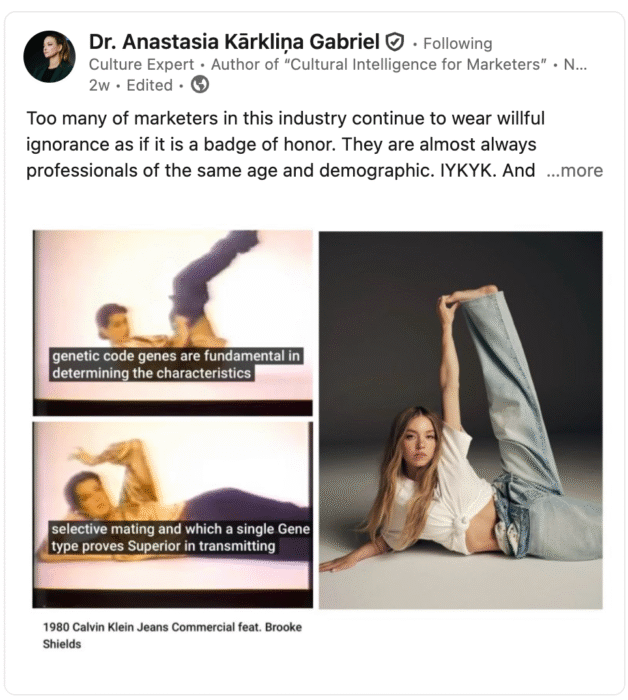
Dr. Anastasia Kārkliņa Gabriel, culture expert and author of Cultural Intelligence for Marketers, in her critique of this campaign, pointed out the historical significance of Sydney Sweeney’s phrase, “My genes are blue.” Semiotically, there’s a connection here to the term “blue blood” or blue-blooded, which is derived from the Spanish phrase “sangre azul.” In the European aristocracy, a person with pale skin and visible blue veins was perceived as having come from a “pure” European lineage, untainted by non-European ancestry.
I doubt American Eagle’s marketing teams were aware of the term “blue blood.” Still, they don’t need to be to have avoided their marketing blunder, because there are so many recent historical markers, including the present political and cultural climate, to know that mixing race with genes in messaging is a horrendous idea — especially when trying to remain culturally relevant with a target audience that happens to be one of the most conscientious consumer generations.
The Bottom Line: Culture Is Everything
What’s the takeaway from all of this? Always consider culture in whatever you do. We don’t live or communicate within a vacuum. Our beliefs, decisions, and semiotics all exist within a cultural framework that gives us meaning and grounds our identity. That’s why cultural intelligence must be woven into every aspect of an organization if it wants to stay relevant and connect authentically with its audiences. Consider this: Consumers are 2.6 times more likely to find brands relevant when advertising feels culturally relevant to them. Ignore culture, and you’re essentially choosing to stop listening to your audience. That’s not just bad business, it’s a recipe for irrelevance — the worst fate any brand can face.
Having a marketing team with members of different backgrounds, cultures, and experiences will also go a long way in helping prevent the PR mess American Eagle found itself in. I suspect some people would have warned them about the campaign when they got wind of it. I bet the team wishes they hadn’t ignored those voices.
Listen, I know we’re not perfect. American Eagle simply wanted a clever campaign that turned heads. They didn’t consider the ramifications of how their messaging might be interpreted by different audiences. Should they have been more culturally aware, especially as a global brand? Hell yes. But every brand has an opportunity to make good on its mistakes, learn from them, and be transparent with its audience, significantly minimizing the damage to its reputation and cultural relevance and building stronger trust with consumers.
As a brand with a mission to be inclusive, American Eagle could have turned this situation around. Unfortunately, they’ve chosen the reckless path of doubling down on their cultural misstep, pointing to their stock surges as a measure of the campaign’s success (while remaining silent about their stagnant revenue and decreased foot traffic), and released a statement that essentially told their audience, sorry not sorry.
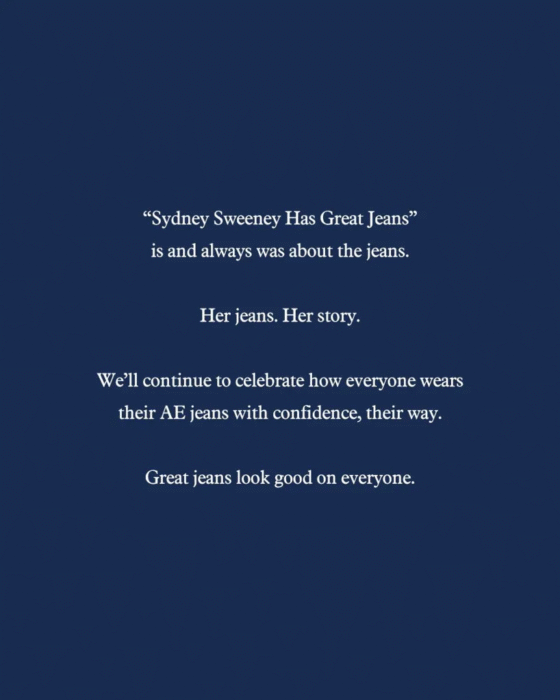
C’mon, American Eagle! Well, kids, I have one more lesson for you. When you mess up and don’t quickly correct course, another brand is ready to capitalize on it and take your place. Just under a month after the Sydney Sweeney campaign debuted, Gap launched its “Better in Denim” ad campaign featuring Los Angeles-based pop group KATSEYE.
This ad is so fun! The messaging is night and day compared to American Eagle’s ad. Gap indeed saw an increase in foot traffic as a result of the campaign, and time will tell if their strategy pays off in acquisitions. More importantly, their alignment with culture and their customers’ values sets the brand up for long-term relevance, underscoring the crucial role of cultural intelligence in marketing.